WORKWARS: The Employee Defense Manual  ·  Now available on Amazon  ·  Paperback & Kindle
New Release · Feb 8, 2026

Stop relying on HR. Don't give up the fight.

A 124-page tactical field guide. Document workplace incidents, handle toxic environments, and let this manual and the WORKWARS app fight for you. Canada, USA, UK.

Disponible en français · Español próximamente

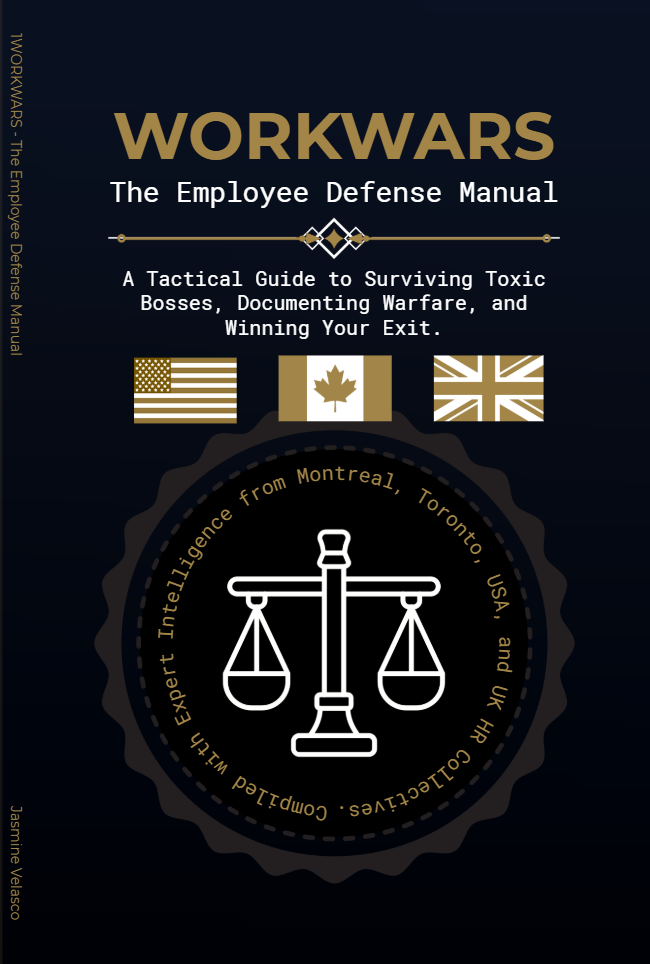
WORKWARS: The Employee Defense Manual by Jasmine Velasco — front cover
124
Pages
3
Core Jurisdictions
10
Tactical Phases
100+
Guides Referenced

If you're in any of these situations, this is your briefing.

The manual isn't theoretical. Each phase maps to real moments where most employees make the legally costly choice — because nobody ever handed them the playbook.

01

Your boss erupts without warning

You walk on eggshells. Meetings are ambushes. You're starting to believe it's your fault.

Phase 01 · Intelligence Gathering
02

HR feels engineered to bury you

Every complaint vanishes. The process protects the organization, not you.

Phase 03 · Rules of Engagement
03

You're burning out and nobody cares

Sleep gone. Weekends gone. "Just push through" isn't a management strategy — it's liability.

Phase 09 · Burnout Liability
04

You think you're being set up to fail

Impossible deadlines. Shifting goalposts. Documentation is your only defense.

Phase 02 · Paper Trail Protocol
05

You're about to quit

Stop. What you do in the next 72 hours determines your severance for the next 2 years.

Phase 04 · The Strategic Retreat
06

You were just fired

Don't sign anything. Don't delete anything. Read Phase 7 first.

Phase 07 · Post-Exit Tactics

Ten tactical phases. One complete doctrine.

Each phase opens with a one-page summary for immediate situational awareness, then deepens into the full doctrine with scripts, templates, and jurisdiction-specific legal frameworks for Canada, the USA, and the UK.

PHASE 01

Intelligence Gathering

The landscape. Identify the "Volcanoes," "Martyrs," and "Silent Slackers." Recognize the "Protector Boss" who enables the bully.

Workplace gaslightingPower mapping
PHASE 02

The Paper Trail Protocol

If it isn't in writing, it never happened. Build a court-ready Daily Recon Log and the Voice-to-Text Arsenal for instant after-action reports.

Daily Recon LogDigital sovereignty
PHASE 03

Rules of Engagement

The "HR is a Tool" strategy. How to bypass the Faragher-Ellerth defense and deliver a Formal Notice Letter in safe legal terms.

Psychological HarassmentTitle VIIACAS Code
PHASE 04

The Strategic Retreat

Constructive Dismissal. The "Just Cause" loophole for Unemployment (EI). The Financial War Room — qualifying hours, 55% math, Service Canada interview.

Constructive dismissalEI qualifying
PHASE 05

The Multilingual Templates

The English Toolkit (US, UK, Canadian), the French Toolkit (Guerres au Travail, CNESST), the Spanish Toolkit, and the Universal Volcano Log.

3-language toolkitVolcano Log
PHASE 06

The Mental Fortress

Stamina and self-care. The "Off-Switch" Protocol, the Decompression Anchor, and recognizing Psychosocial Hazards — role ambiguity, workload manipulation, social isolation.

Psychosocial hazardsRight to Disconnect
PHASE 07

Post-Exit Tactics

The "Fair Reference" agreement. Negotiating the Exit Package and Settlement Agreement. The NDA "gag order" and the 2026 restrictions that protect you.

Neutral referenceSeverance strategy
PHASE 08

The Digital Panopticon

Privacy and AI. Recognize Automated Decision Systems (ADS), the Transparency Notice, your Right to Inspect the data they hold, and how to manage Technostress & FOBO.

AI surveillanceRight to Inspect
PHASE 09

The Burnout Liability

Health as evidence. Track your "Decision Velocity." Foreseeability as a weapon — if you warned them, their Duty of Care failure becomes your legal leverage.

Duty of CareForeseeability
PHASE 10

The Narrative Rebuild

Explaining the gap. Framing your exit as an "intentional choice for professional alignment." The Interview Cardinal Rule — never blame, always pivot.

Career sabbatical framingInterview pivot
APPENDIX A

Reference Negotiation Script

Word-for-word scripts for negotiating your exit reference, with escalation paths when the employer refuses a neutral reference policy.

Full script
APPENDIX B

The HR Translator

From "Toxic" to "Technical." Convert emotional grievances into clinical, risk-focused language HR cannot legally ignore, with location-specific Power Terms.

Translation tablePower Terms
Jasmine Velasco — Author & Founder, WORKWARS
Jasmine Velasco Author & Founder

A collaborative voice for workplace power dynamics.

Jasmine Velasco is the public-facing voice behind a global investigative and systems-driven initiative focused on workplace power dynamics, employee protection, and real-world compliance failures.

Her work is powered by a distributed network of contributors across Montreal, Toronto, New York City, the United Kingdom, and Japan — bringing together perspectives from recruitment, HR, legal-adjacent professionals, and frontline management environments. This collaboration forms the foundation of WORKWARS, a platform designed to expose, document, and navigate the realities of modern employment systems.

Unlike traditional self-help or business writing, Jasmine's publications are built as operational manuals — structured to help readers move from confusion to execution. Her work focuses on translating complex, often opaque systems into clear, actionable frameworks that individuals can use immediately.

"Her latest release is not theory — it is a field guide."

WORKWARS: The Employee Defense Manual consolidates patterns observed across multiple jurisdictions, including Canada, the United States, and the United Kingdom, and equips readers with structured methods to document incidents, manage escalation, and protect themselves in high-risk workplace environments.

Part of a broader ecosystem
  • A multilingual platform (3+ languages) for worker education
  • A companion application available in 20+ languages
  • Structured tools for incident tracking, evidence documentation, and case preparation

Collaboration & Contributions. Jasmine Velasco operates as a collaborative identity. The platform actively works with industry insiders who provide real-world insight while maintaining anonymity, professionals and advisors contributing to structured guidance systems, and organizations seeking to improve transparency and public trust.

The Mission

To reduce the information imbalance between individuals and institutions — and to provide people with the tools to navigate systems that were never designed to be easily understood.
Don't get mad. Get clinical.

Most employees lose their leverage before they even realize they had it.

Get everything in writing. Get the manual today.

This manual is not passive reading. It's a system you can use.

Get the Manual on Amazon →
Paperback & Kindle · Ships worldwide · Also available in French

Answers before you commit.

Who is this book for?

Employees currently navigating toxic bosses, workplace harassment, unmanaged burnout, or considering their exit. It's also for anyone wanting to understand their legal position before the situation escalates. The manual serves professionals in Canada, the USA, and the UK.

What jurisdictions does the book cover?

Canada (including Quebec's Article 81.18 and CNESST psychosocial hazard standards), the United States (OSHA, Title VII, state-level protections), and the United Kingdom (Equality Act 2010, constructive dismissal case law).

How is this different from a typical self-help book on toxic workplaces?

It's not self-help. It's a tactical doctrine. You won't find affirmations or emotional reframing. You'll find court-ready documentation protocols, HR translation scripts, and the specific legal frameworks that give your position teeth.

What is constructive dismissal?

Constructive dismissal occurs when an employer unilaterally changes a fundamental term of your employment — compensation, duties, reporting structure, location — or creates conditions hostile enough that a reasonable person would feel forced to resign. Legally, it's treated as termination without cause, meaning you may be owed the same severance as if you were fired outright. Phase 04 of the manual — The Strategic Retreat — covers this in depth for Canada, USA, and UK, including the "Just Cause" loophole for qualifying for Unemployment (EI).

Can I sue my employer for workplace harassment?

In most jurisdictions the first step is a formal internal complaint, followed by escalation to an external tribunal or regulator — CNESST in Quebec, the EEOC in the United States, ACAS and employment tribunals in the United Kingdom. Civil litigation is usually a later option once administrative remedies are exhausted. The manual's HR Translator Protocol and Paper Trail Protocol are the documentation foundation that makes any of these steps viable.

How much severance am I entitled to?

It depends on jurisdiction, tenure, position, age, and whether you were terminated with or without cause. In Canada, the Bardal factors govern reasonable notice and commonly produce roughly one month per year of service for mid-level roles, with higher awards for senior employees. US at-will states often default to WARN Act thresholds and any negotiated severance agreement. UK statutory redundancy pay follows a specific formula tied to weekly pay caps. Phase 04 (The Strategic Retreat) and Phase 07 (Post-Exit Tactics) walk through each framework with calculation examples and negotiation scripts.

Can I use this without a lawyer?

The manual is designed to prepare you before you need one, and to make you an informed client when you do. It's not a substitute for licensed legal counsel, but it is the briefing document that makes your first consultation ten times more productive.

Is there a French edition?

Yes. The French edition is titled WORKWARS: Le Manuel de Défense de l'Employé and is available on Amazon as well. Access the French landing page →

How do I document workplace harassment properly?

Properly means court-ready. Build a Daily Recon Log with three disciplined elements: precise timestamps (date + hour + minute), verbatim quotes in quotation marks rather than paraphrases, and named witnesses. Store the log on personal hardware, not company devices — this is what Phase 02 calls Digital Sovereignty. Back up critical entries to a timestamped, non-editable PDF the same day. The Voice-to-Text Arsenal in Phase 02 covers the apps and workflows that make this a 5-minute-a-day habit rather than a project.

Can I sue HR for ignoring my harassment complaint?

You typically sue the employer, not HR as a department — but HR's failure to act is often the evidence that establishes liability. In the US, the Faragher-Ellerth defense allows employers to escape harassment claims if they can prove they had a working complaint system and you didn't use it; Phase 03 of the manual covers how to bypass that defense by documenting that you did report and HR took no corrective action. In Canada and the UK, a similar principle applies through the employer's statutory Duty of Care. Proper documentation of HR's inaction is what shifts the legal exposure back onto the organization.

What proof do I need for constructive dismissal?

You need to establish two things: (1) a fundamental, unilateral change to your employment terms — compensation cut, demotion, significant role change, hostile conditions, forced relocation — and (2) that a reasonable person in your position would have felt forced to resign. The evidence that carries weight: dated written communications showing the change, your documented objection or request for resolution, the employer's response (or silence), and your Paper Trail showing the timeline. Quitting too quickly, or without written protest, can weaken your claim. Phase 04 walks through the exact sequence and the Formal Notice Letter from Phase 03 that preserves your leverage.

What is the 'HR Translator' technique?

A method for converting emotional grievances ("my boss is mean") into clinical, statute-linked language ("sustained conduct constituting psychological harassment under Article 81.18 LSA") that obligates HR to document and respond — because the legal exposure of ignoring it becomes real.

How long does it take to read?

The manual uses a two-tier structure. One-page executive summaries can be consulted in under five minutes for immediate crisis management. Full doctrines run longer for strategic planning. Most readers finish the core material in three to five sittings.